
Prairie Village Directory Years
Johnson County Library is the main shelf for Prairie Village city directory research. Its catalog proves several distinct runs rather than one unbroken annual set. The oldest clearly identified local item is the R.L. Polk Mission directory for 1962 through 1964, which expressly includes Prairie Village. A countywide Polk run covers 1997 through 2000, followed by catalog records for north and south Johnson County volumes from 2000 onward. Cole volumes add an address-first view beginning in 1985. All are cataloged for in-library use, so call ahead and ask staff which branch currently holds the year needed.
| Collection | Years | Where Held | Access |
|---|---|---|---|
| Mission R.L. Polk directory | 1962-1964 | Johnson County Library | In-library |
| Polk directory for Johnson County | 1997-2000 | Johnson County Library | In-library |
| North and South Johnson County Polk | 2000-present catalog listing | Johnson County Library | In-library |
| Cole cross-reference directories | 1985-2000; 2001-present listing | Johnson County Library | Inspect in branch |
| U.S. telephone directory reel | 1962 locality index | Library of Congress | Free online |
The catalog does not promise that every year exists or that every volume treats Prairie Village the same way. The Library of Congress notes that directory publication can be irregular, with gaps of several years. The online 1962 telephone-directory reel lists Prairie Village as a locality, but no standalone household page was found during research. Record an absent year as a gap, then move to a census, obituary, deed, tax abstract, or newspaper instead of assuming the household disappeared.
Prairie Village Genealogy Desk
The Johnson County Library Genealogy Desk pairs the library with the Johnson County Genealogical Society, a partnership dating to 1972. Its main research base is the Central Resource Library at 9875 W. 87th Street in Overland Park. Volunteers are listed Monday through Saturday from 9:00 a.m. to 4:00 p.m. and Sunday from 2:00 to 4:00 p.m. Researchers can use computers, books, microfilm, microfiche, old books, and local periodicals. The desk also offers one-on-one help in person or by Zoom.
Start with a year, surname, street, or subdivision. That focused request gives staff a much better route to the right Prairie Village city directory than a broad family-name search. The library genealogy and local-history guide also points to newspapers, photographs, cemetery material, and licensed databases. Its FamilySearch affiliate access can reveal added images inside the branch.
The library catalog search shows the actual city directory records available for inspection.
Open the Johnson County Library city-directory catalog search before visiting.
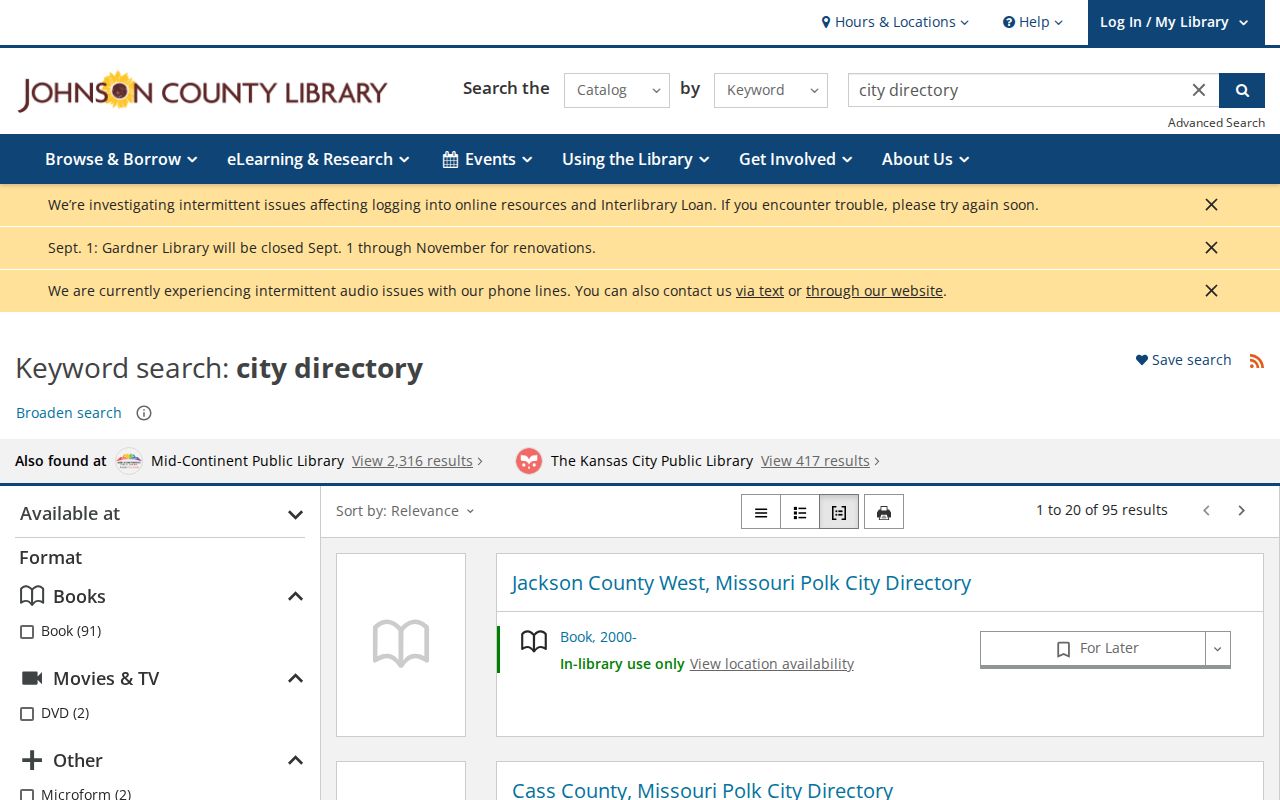
The catalog screen helps distinguish Polk name directories from Cole reverse volumes, so the search method can match the known fact.
Read Prairie Village Directory Entries
No named sample entry was captured from the in-library Polk or Cole books, so do not assume that all volumes print the same fields. At the branch, copy the entry exactly and photograph the volume's abbreviation key under library rules. A Prairie Village city directory may arrange a household by surname, while a reverse section begins with the street and house number. Compare the same address in the next available year before deciding that a move, death, or name change occurred.
| Printed name | Surname, given name, middle initial, and household notation as shown |
|---|---|
| Household detail | Spouse or other notation only when the volume supplies it |
| Work detail | Occupation, employer, or business affiliation when printed |
| Home address | House number, street, city, and ZIP exactly as typeset |
| Address key | The matching street-order entry in a reverse section |
- Criss-cross directory
- A reverse directory arranged by street and house number rather than surname.
- Householder index
- A list centered on the person identified as the main household entry.
- Abbreviation key
- The volume's own guide to shortened words and marks. Save it before interpreting an entry.
A directory is a dated lead, not proof of a complete household. Unlisted people, recent moves, and publication lag can all affect what appears.
Prairie Village Cole Address Search
Cole's Cross Reference Directory gives Prairie Village city directory work an address-first route. Johnson County Library catalogs a Kansas City and suburbs run for 1985 through 2000 and a Kansas City and vicinity record from 2001 onward. Both are regional works, so confirm that the specific Prairie Village street falls within the volume at hand. Start at the street name, scan house numbers in order, then turn to the surname portion for any linked name details.
This is useful when a family name is unknown, misspelled, or changed between volumes. It also reveals the sequence of listed addresses on a block without treating every nearby entry as a current resident. For a modern street-based inquiry, the Prairie Village street directory explains the county parcel and deed chain; the Cole volumes are best used for the historical address layer.
Note: Reverse-directory coverage is regional and catalog-based, so verify the year and Prairie Village street inside the physical volume.
Prairie Village Obituary Card File
The library's Johnson County obituary card file spans 1977 through 2000. It is a strong companion to city directories when a listing stops or a household changes. A card is a citation aid, not always the full obituary. Search the name and date, then follow the citation into the newspaper or JoCoHistory Prairie Village collection. JoCoHistory also holds photographs, aerial views, local articles, school and church material, and place metadata that can connect a printed address to a real neighborhood.
Keep the evidence in date order. A city directory can place a printed name at an address for its publication period. An obituary may identify relatives and an event date. A newspaper or yearbook can supply context. None should be stretched into proof of present residence. When a directory result needs a check against modern official systems, use the Prairie Village resident lookup workflow.
The library's broader genealogy page shows the mix of indexes and branch-only resources available.
Review the Johnson County Library genealogy resources before choosing the next source.
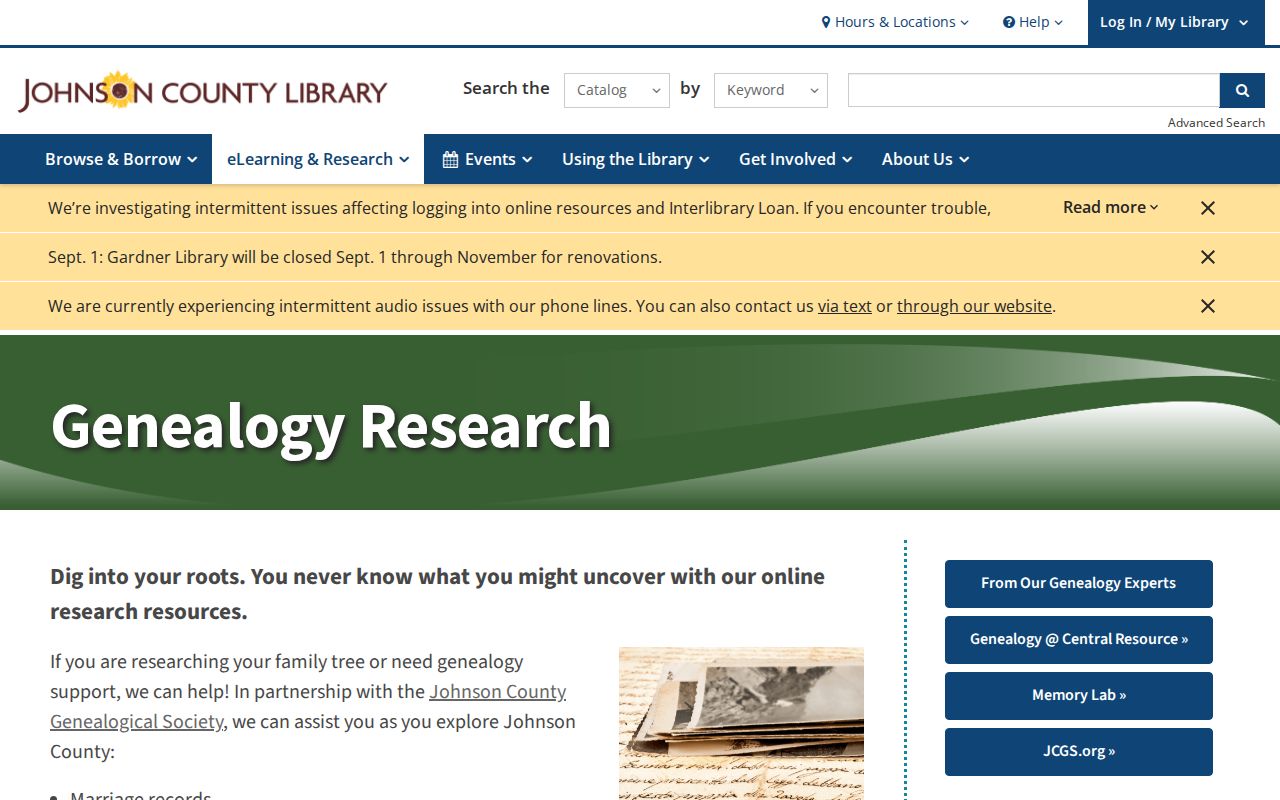
The captured page makes clear why a directory find often leads next to newspapers, obituary citations, photographs, or FamilySearch access.
Prairie Village Directory Timeline
Prairie Village became a city during a fast period of suburban growth, while county land and family records began much earlier. This explains why no single city directory can cover the full local story. Older farm and tract references may precede the city name; later Polk and Cole books reflect a mature street grid. Use the timeline to pick the type of source that fits the date.
| Year | Local record context |
|---|---|
| 1855 | Official city history identifies an oldest local home from this era. |
| 1941 | Construction of the planned community began. |
| 1949 | The community received national planned-community recognition. |
| 1951 | Prairie Village incorporated on February 19. |
| 1957 | Prairie Village became a first-class city. |
| 1962-1964 | The cataloged Mission Polk run expressly includes Prairie Village. |
| 1985 onward | Cataloged Cole reverse-directory runs add address-first searching. |
The city is landlocked, and postal labels can differ from the municipal name. If a street vanishes from a directory search, test Leawood or Overland Park labels where ZIP and postal history support them.
Prairie Village History Beyond Directories
The Johnson County Museum holds more than 3,000 cubic feet of records and takes research visits by appointment. Its government-record holdings include Prairie Village property abstracts from 1855 through 1985. Those abstracts can bridge a farm tract, postwar subdivision, and later owner when city directory years are sparse. Ask for a tract, address, or known abstract rather than a broad surname sweep. The Johnson County Historical Society adds atlases, farm directories, aerial photographs, soil maps, deed books, and personal collections.
The All-Electric House offers a human-scale example. It originally stood at 4602 Homestead in Indian Fields, and former-owner and neighbor oral histories are available through JoCoHistory. That collection can add voices and photographs to a dated directory entry without turning memory into ownership proof. The city also points to an 1855 home, a 1950 Ferraro house, and a 1954 Prairie Fields family story as leads worth testing in primary records.
Research tip. County Archives provides up to 30 minutes of staff research before charging $25 per hour, so ask for a tract, year, or record series.
Trace Prairie Village Family History
A careful Prairie Village city directory trail records both what is present and what is missing. Begin with a known name or address, cite the volume and page, and keep the printed spelling. Move one available year at a time. Then pair the directory sequence with census years, deeds, property abstracts, obituaries, and local photographs. The National Archives now provides federal census schedules through 1950, but early schedules may require a Johnson County, township, street, or enumeration-district search because Prairie Village did not exist as an incorporated place before 1951.
- Find the first available surname entry and copy every printed field.
- Check the prior and next available volumes, noting address and household changes.
- Use the Cole street-order section to test the same house number and nearby listings.
- Pair the directory period with the closest census, deed, tax abstract, or newspaper.
- Close a gap with the obituary card file, JoCoHistory, cemetery contact, or county archive.
A missing name has several possible meanings: the person moved, died, changed a printed name, chose not to be listed, or fell into a publication gap. Confirm the reason with a second source. Corinth Cemetery, founded in 1871 and now full, has no public name-search database found in the research, so its office and forms are an honest offline fallback rather than an assumed online index.
Check the Genealogy Desk's current access details before a research visit.
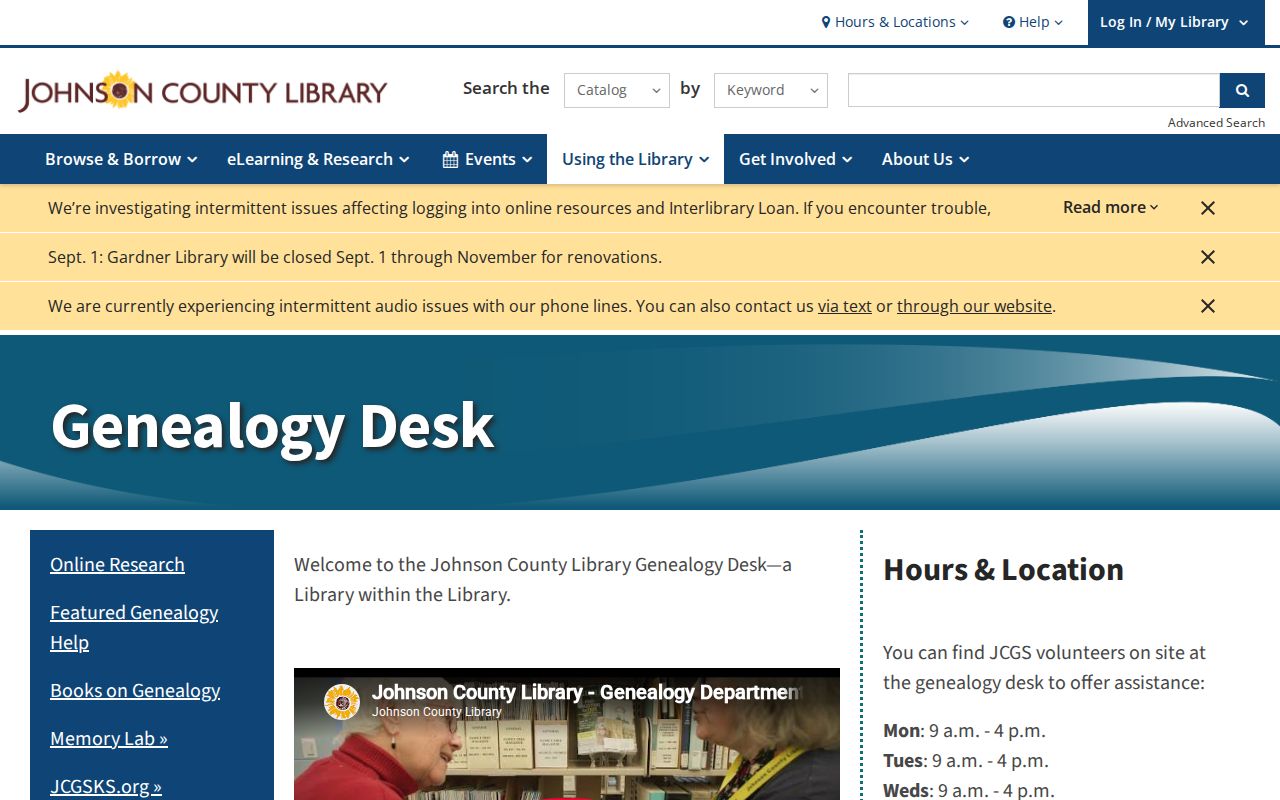
The desk page confirms the local staff, hours, and research tools that make the in-library directory runs usable.